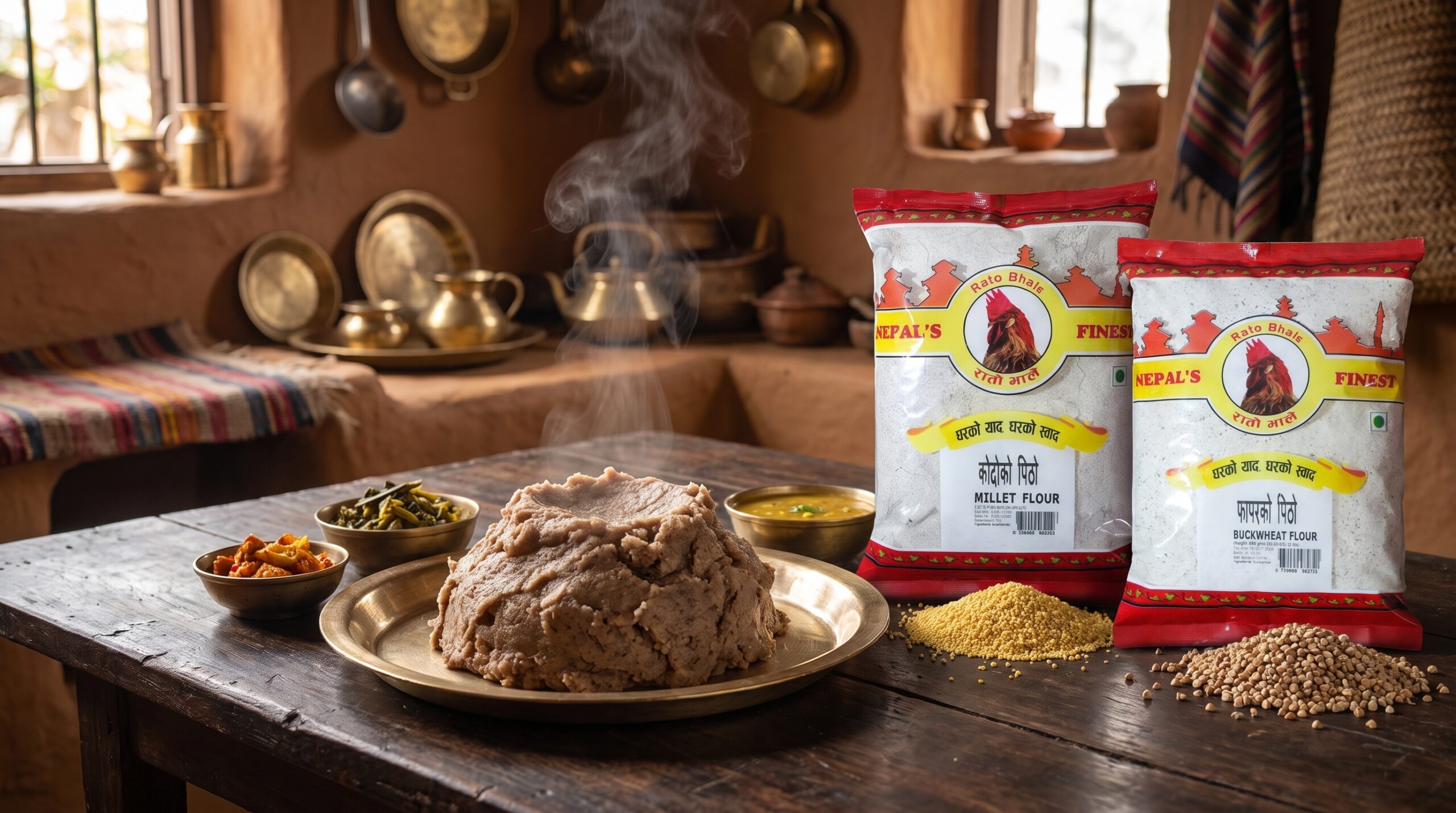
When people think about traditional Nepali food, dal bhat may be the first dish that comes to mind. But throughout the hills and mountains of Nepal, another humble and deeply traditional dish has been enjoyed for generations: Dhindo.
Simple, hearty and versatile, Dhindo is traditionally prepared by cooking flour with hot water and continuously stirring it until it develops its characteristic thick and smooth texture.
Depending on the region, household and ingredients available, Dhindo can be made using different traditional flours, including millet, buckwheat and maize (corn).
With Rato Bhale Millet Flour, Buckwheat Flour and Makai/Corn Flour, you can prepare traditional-style Dhindo at home. And the possibilities do not stop there. These same flours can also be used to make roti, pancakes and other everyday dishes.
What Is Dhindo?
Dhindo is a traditional Nepali dish made by gradually adding flour to boiling water while stirring continuously.
As the flour cooks, it absorbs the water and thickens, creating a dense and smooth dish. Traditionally, a wooden utensil may be used to stir the mixture as it cooks.
At its simplest, Dhindo requires only a few ingredients:
- Flour
- Water
- Salt, if desired
The simplicity is part of its charm.
Dhindo is commonly served with traditional accompaniments such as gundruk, achar, vegetables, lentils, yogurt, buttermilk or meat-based curries. The relatively mild flavor of the cooked flour allows the accompanying dishes to provide the spice, sourness and richness.
Why Are Millet, Buckwheat and Corn Used for Dhindo?
One of the most interesting things about Dhindo is that there is no single flour that must be used.
Nepali households have traditionally made use of grains that were locally available, resulting in different varieties of Dhindo across the country.
Millet Flour
Millet is an important traditional grain used in many parts of Nepal.
Millet flour gives Dhindo a distinctive earthy flavor and hearty texture. Rato Bhale Millet Flour can be used to prepare traditional-style millet Dhindo and can also be used in recipes such as roti and pancakes.
Buckwheat Flour
Buckwheat, known in Nepal as Phapar, is another traditional grain associated with Nepali cuisine.
Buckwheat flour has a naturally earthy and nutty flavor, making it an excellent choice for Dhindo and traditional flatbreads.
Buckwheat is also naturally gluten-free. However, people with celiac disease or a wheat allergy should check product labeling and potential cross-contact before consuming any particular flour.
Makai / Corn Flour
Makai, or maize, is another familiar traditional grain in Nepali kitchens.
Corn flour gives Dhindo a distinctive corn flavor and can also be used to make flatbreads and pancakes.
Having Makai/Corn Flour in the kitchen therefore gives you plenty of options beyond Dhindo.
How to Make Traditional Millet Dhindo
Millet flour is a great choice if you want to try making Dhindo at home.
Ingredients
- 1 cup Rato Bhale Millet Flour
- 2½–3 cups water
- Salt, optional
- A small amount of ghee or butter, optional
Method
1. Boil the water.
Place the water in a heavy-bottomed pot and bring it to a boil. Add a little salt if desired.
2. Add the flour gradually.
Reduce the heat slightly and slowly add the millet flour.
3. Start stirring.
Using a strong wooden spoon or traditional Dhindo stick, begin stirring continuously.
4. Cook and stir.
Continue stirring as the flour absorbs the water and thickens. Keep cooking until the mixture becomes smooth and cohesive.
5. Adjust the texture.
If the Dhindo is too stiff, add a small amount of hot water. If it is too soft, continue cooking and stirring until it reaches your preferred consistency.
6. Serve hot.
Serve immediately with your favorite Nepali accompaniments.
Try it with gundruk ko jhol, dal, achar, vegetables, yogurt or a flavorful meat curry.
How to Make Buckwheat Dhindo
For a nuttier and more earthy version, try Rato Bhale Buckwheat Flour.
Ingredients
- 1 cup Rato Bhale Buckwheat Flour
- 2½–3 cups water
- Salt, optional
Method
Bring the water to a boil and add salt if desired.
Gradually add the buckwheat flour while stirring continuously. Keep the heat moderate and continue stirring until the flour absorbs the water and the mixture becomes thick and smooth.
Buckwheat has a distinctive flavor, so it pairs particularly well with bold accompaniments such as spicy achar, gundruk, vegetables and savory curries.
How to Make Makai/Corn Dhindo
If you enjoy the flavor of maize, Rato Bhale Makai/Corn Flour can be used to make a flavorful corn-based Dhindo.
Ingredients
- 1 cup Rato Bhale Makai/Corn Flour
- 2½–3 cups water
- Salt, optional
Method
Bring the water to a boil.
Slowly add the corn flour while stirring continuously. Continue cooking until the mixture thickens and becomes cohesive.
Keep stirring until you reach the consistency you prefer.
Serve hot with achar, vegetables, dal, gundruk or your favorite curry.
Make Roti with Rato Bhale Flours
Traditional Nepali meals are often accompanied by different types of flatbreads. These flours can be used to create your own versions at home.
Millet Roti
Millet flour can be mixed with hot water to form a soft dough.
Simple method:
- Place millet flour in a bowl.
- Add a little salt if desired.
- Gradually add hot water.
- Mix carefully until the flour comes together.
- Allow the dough to cool enough to handle safely.
- Divide it into small portions.
- Flatten each portion between your hands or between sheets of food-safe paper.
- Carefully place it on a hot pan.
- Cook both sides until done.
Millet dough can be more delicate than wheat dough, so working gently helps prevent cracking.
Buckwheat Roti
Buckwheat flour can also be used to make traditional-style flatbreads.
Mix the flour with hot water and a little salt to form a manageable dough. Shape the dough into small flatbreads and cook them on a hot pan.
Buckwheat’s naturally nutty flavor makes these rotis particularly good with achar, yogurt, vegetables or curry.
Makai/Corn Roti
Corn flour can be used to make a rustic and flavorful flatbread.
Mix the flour with hot water and form a soft dough. Flatten carefully and cook on a hot tawa or skillet until cooked through.
Corn roti pairs well with spicy pickles, vegetables and hearty curries.
Make Pancakes with Rato Bhale Flour
Here’s where these traditional flours become especially interesting.
You do not have to use them only for traditional Nepali dishes. They can also become part of a modern breakfast.
Millet Pancakes
For a simple pancake batter, combine:
- 1 cup Rato Bhale Millet Flour
- 1 egg
- ¾–1 cup milk
- 1 teaspoon baking powder
- A small pinch of salt
- Honey or sugar, optional
Mix until you have a smooth batter.
Heat a lightly greased pan and pour a small amount of batter onto it.
Cook until bubbles appear on the surface, then flip and cook the other side.
Serve with honey, fruit, yogurt or your favorite topping.
Buckwheat Pancakes
Buckwheat is particularly well suited to pancakes because its naturally earthy flavor works with both sweet and savory ingredients.
Try combining:
- Rato Bhale Buckwheat Flour
- Milk
- Egg
- Baking powder
- A small amount of salt
- Honey or sugar, depending on your preference
Cook the pancakes on a medium-hot pan and serve with fruit, yogurt or honey.
For a savory version, leave out the sugar and serve with vegetables, achar or another savory topping.
Corn Pancakes
Rato Bhale Makai/Corn Flour can also be used for pancakes.
Corn-based pancakes can be made sweet or savory depending on what you add to the batter.
For breakfast, try honey and fruit.
For a savory meal, try herbs, vegetables or spices.
What Goes Well with Dhindo?
Dhindo is traditionally enjoyed with flavorful side dishes.
Gundruk
The sour, fermented flavor of gundruk provides a wonderful contrast to the mild taste of Dhindo.
Achar
Spicy and tangy achar adds brightness and heat to the meal.
Dal
A bowl of dal provides a comforting accompaniment to freshly prepared Dhindo.
Vegetables
Seasonal vegetable curries make a simple and satisfying combination.
Yogurt or Buttermilk
Cool yogurt or buttermilk provides a refreshing contrast to hot Dhindo.
Meat Curries
For those who eat meat, Dhindo can also be served alongside flavorful chicken, goat or buffalo curries.
Bringing Traditional Nepali Food to Kitchens Around the World
For Nepalis living outside Nepal, traditional foods can be an important connection to home.
A meal of Dhindo with achar and gundruk can bring back memories of family kitchens, village homes and meals shared around the table.
But these ingredients are not only for Nepalis.
As interest in traditional grains and international cuisines continues to grow, foods such as millet, buckwheat and corn offer home cooks new ways to explore different flavors and cooking traditions.
Rato Bhale makes these traditional Nepali flours available for people who want to recreate familiar recipes or experiment with something new.
One Flour, Many Possibilities
This is what makes traditional grains so exciting.
A bag of Rato Bhale Millet Flour does not have to mean making the same recipe every time.
You can make:
Millet Flour → Dhindo → Roti → Pancakes
Buckwheat Flour → Dhindo → Roti → Pancakes
Makai/Corn Flour → Dhindo → Roti → Pancakes
The same traditional ingredients can be used in both classic Nepali recipes and modern everyday cooking.
Try Dhindo Your Way
There is no single way to enjoy Dhindo.
Try millet for an earthy, traditional flavor. Choose buckwheat for its distinctive nutty character. Or use Makai/Corn Flour for a naturally corn-forward version.
Then take the same flour beyond Dhindo.
Make a roti.
Make a pancake.
Experiment with a new recipe.
That is the beauty of traditional ingredients: they carry the history of a cuisine while still giving you the freedom to create something new.
Taste the Tradition with Rato Bhale
Dhindo is a simple dish, but it represents something much bigger—the relationship between Nepali food, traditional grains and generations of cooking traditions.
With Rato Bhale Millet Flour, Buckwheat Flour and Makai/Corn Flour, you can bring these traditional grains into your kitchen and explore them in more ways than one.
Make Dhindo the traditional way.
Turn the flour into roti.
Or give it a modern twist with pancakes.
From the traditional Nepali kitchen to homes around the world, Rato Bhale brings the taste of Nepal closer to you.
Talk to Our Trade Expert
Get personalized guidance on sourcing, pricing, and export logistics from our experienced trade specialists.
Schedule a Free Consultation