

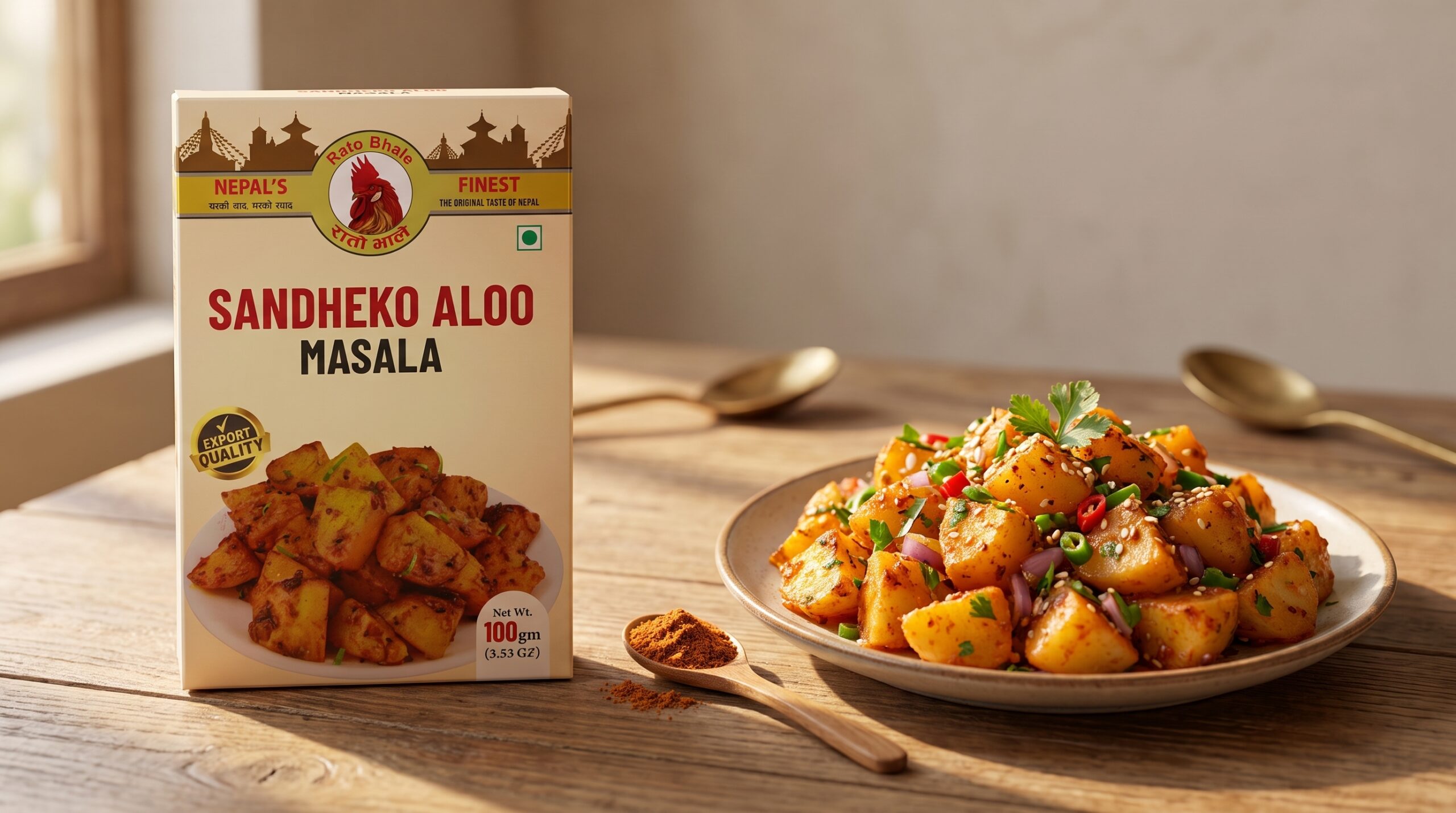
If you are looking for a simple Nepali dish with spicy, tangy and aromatic flavours, Sandheko Aloo is a great place to start.
Sandheko Aloo is a traditional Nepali potato dish made by tossing cooked potatoes with aromatic spices, chilli, mustard oil and other fresh ingredients. It is often enjoyed as a snack, side dish or accompaniment to a traditional Nepali meal.
The word “sandheko” refers to the way ingredients are seasoned and tossed together, allowing the spices, oil and other flavours to coat the main ingredient. Aloo Sandheko is commonly described as a Nepali potato salad, but unlike a typical Western potato salad, its flavour comes from ingredients such as mustard oil, chilli, citrus and traditional spices.
In this guide, we will explain what Sandheko Aloo is, what makes a good Sandheko Aloo, how it is traditionally prepared, and how Rato Bhale Sandheko Aloo Masala can be used to make this popular Nepali dish.
What Is Sandheko Aloo?
Sandheko Aloo is a traditional Nepali potato dish made by seasoning and tossing cooked potatoes with spices and aromatic ingredients.
The main ingredient is simple:
Aloo = Potato
But the flavour comes from how the potato is seasoned.
Traditional preparations can include ingredients such as:
- Boiled potatoes
- Mustard oil
- Chilli
- Onion
- Garlic
- Lemon or lime
- Cumin
- Timur
- Fenugreek
- Coriander
- Salt
- Other traditional spices
The exact ingredients vary between recipes and households.
What makes the dish special is the combination of soft potato, spicy seasoning, aromatic spices and tangy acidity.
What Does “Sandheko” Mean?
The term Sandheko describes a style of preparing food by mixing or dressing the main ingredient with seasoning and other flavouring ingredients.
In the case of Sandheko Aloo, cooked potatoes are combined with spices, oil, chillies and other ingredients so that the flavour coats the potato.
This technique is not limited to potatoes. Nepali cuisine also has other types of Sandheko dishes made with ingredients such as chicken, soybeans and peanuts. Nepal Tourism Board’s heritage cuisine recipe material also notes that Sandheko can be prepared using vegetarian ingredients such as potato, soybean and peanuts, with spices varying according to local and ethnic practices.
What Makes a Good Sandheko Aloo?
Making Sandheko Aloo is simple, but a few details make a big difference.
1. The Potatoes Should Be Cooked Properly
The potatoes should be cooked until tender but should still hold their shape.
If they become too soft, they can break apart when mixed with the spices.
If they are undercooked, the texture will be hard and the seasoning will not combine properly with the potato.
2. The Spices Should Be Balanced
A good Sandheko Aloo should have a balance between:
Spicy + Tangy + Salty + Aromatic
No single flavour should completely overpower the potato.
This balance is what makes the dish so enjoyable as a snack or side dish.
3. Mustard Oil Adds Character
Mustard oil is commonly used in Nepali preparations of Sandheko Aloo.
Its strong aroma works particularly well with chilli and traditional spices.
Some traditional preparations heat the mustard oil before combining it with spices, helping release the aroma of the seasoning.
4. Fresh Ingredients Matter
Ingredients such as:
- Red onion
- Green chilli
- Coriander
- Lemon or lime
can add freshness and brightness to the finished dish.
The combination of fresh ingredients with traditional spices gives Sandheko Aloo its distinctive character.
What Is Sandheko Aloo Masala?
Sandheko Aloo Masala is a spice blend specifically made to help prepare Sandheko Aloo.
Rato Bhale describes its Sandheko Aloo Masala as a traditional Nepali spice blend made for Sandheko Aloo, delivering tangy, spicy and aromatic flavour.
Instead of measuring and combining several individual spices every time you prepare the dish, a prepared Sandheko Aloo Masala provides a convenient way to bring traditional seasoning into the recipe.
This makes it useful for:
- Home cooks
- Restaurants
- Nepali food businesses
- People living outside Nepal
- Anyone learning to prepare Nepali food
How to Make Sandheko Aloo Using Rato Bhale Sandheko Aloo Masala
The basic idea is simple:
Cook the potatoes → prepare the ingredients → add Sandheko Aloo Masala → toss → adjust the flavour → serve
The exact amount of Rato Bhale Sandheko Aloo Masala should be adjusted according to your preferred level of spice and the preparation instructions on the product packaging.
Step 1: Cook the Potatoes
Start by boiling the potatoes until they are tender.
They should be cooked through while still firm enough to hold their shape when mixed.
Allow them to cool enough to handle, then peel them if required.
Step 2: Cut or Break the Potatoes
Cut the potatoes into medium-sized pieces.
You don’t need perfectly uniform cubes.
Slightly rough pieces can work well because the uneven surfaces allow the seasoning to coat the potato.
Step 3: Prepare the Fresh Ingredients
Prepare your preferred combination of:
- Onion
- Green chilli
- Coriander
- Garlic
- Lemon or lime
The amount can be adjusted according to taste.
Step 4: Add Rato Bhale Sandheko Aloo Masala
Place the cooked potatoes into a mixing bowl.
Add:
Rato Bhale Sandheko Aloo Masala
The masala is specifically formulated for Sandheko Aloo and provides the characteristic spicy, tangy and aromatic seasoning associated with the dish.
Step 5: Add Mustard Oil
Add mustard oil according to your preferred recipe.
The oil helps distribute the seasoning across the potatoes while contributing its distinctive aroma.
Step 6: Add Fresh Ingredients
Add your prepared onion, chilli, coriander and other fresh ingredients.
If you enjoy a more tangy Sandheko Aloo, add lemon or lime juice according to taste.
Step 7: Toss Everything Together
Now gently toss the potatoes with the masala, oil and fresh ingredients.
Don’t mash the potatoes.
The goal is to keep the potato pieces intact while coating them evenly with the seasoning.
Step 8: Taste and Adjust
This is where you can personalize your Sandheko Aloo.
Depending on your preference, you can adjust:
Spice → Add chilli
Tanginess → Add lemon/lime
Saltiness → Adjust salt
Aroma → Add fresh coriander or mustard oil
The finished dish should have a good balance of spicy, tangy and aromatic flavours.
The Rato Bhale Way to Make Sandheko Aloo
This is where I want you to show the actual Rato Bhale product.
Put your Rato Bhale Sandheko Aloo Masala package next to:
- Boiled potatoes
- Red onion
- Green chilli
- Coriander
- Lemon/lime
- Mustard oil
- Finished Sandheko Aloo
Caption:
Rato Bhale Sandheko Aloo Masala used to prepare spicy, tangy and aromatic Nepali Aloo Sandheko.
This is much better than simply putting a product photograph into the article because the reader immediately understands:
What is it? → How do I use it? → What does it make?
What Does Sandheko Aloo Taste Like?
A good Sandheko Aloo combines several flavours and textures.
Spicy
Chilli and traditional spices provide heat.
Tangy
Lemon or lime and the seasoning create a bright, tangy flavour.
Aromatic
Mustard oil and spices give the dish its characteristic aroma.
Soft
The potato remains tender while the seasoning coats its surface.
Fresh
Onion, green chilli and coriander add freshness.
The result is a dish that is spicy, tangy, aromatic and satisfying without requiring a complicated cooking process.
How Is Sandheko Aloo Served?
Sandheko Aloo can be enjoyed in several ways.
As a Snack
It can be served as a quick spicy snack on its own.
As a Side Dish
Serve it alongside a traditional Nepali meal.
With Chiura
Sandheko Aloo pairs particularly well with Chiura, or Nepali beaten rice.
The contrast between crunchy/light chiura and seasoned potatoes makes a simple but satisfying combination.
As Part of a Nepali Feast
Sandheko-style dishes are also associated with Newari and broader Nepali food traditions and can appear as part of larger meals and gatherings.
Why Is Sandheko Aloo Popular?
One reason Sandheko Aloo remains popular is its simplicity.
You don’t need an elaborate cooking process or expensive ingredients.
The foundation is simply:
Potatoes + spices + oil + fresh ingredients
Yet the combination creates a strong flavour profile.
This makes Sandheko Aloo suitable for everyday meals, snacks, gatherings and traditional food spreads.
Sandheko Aloo vs. Regular Potato Salad
Although Sandheko Aloo is sometimes described as a Nepali potato salad, it is quite different from many Western-style potato salads.
| Sandheko Aloo | Typical Creamy Potato Salad |
|---|---|
| Nepali preparation | Common Western preparation |
| Mustard oil commonly used | May use mayonnaise or other creamy dressing |
| Spicy and tangy | Often creamy and mild |
| Chilli and traditional spices | Often herbs and creamy dressing |
| Lemon/lime commonly used | May use vinegar |
| No need for a creamy dressing | Often built around a creamy dressing |
Sandheko Aloo is therefore best understood as a spiced and dressed Nepali potato preparation, rather than simply another version of creamy potato salad.
Rato Bhale Sandheko Aloo Masala
Rato Bhale Sandheko Aloo Masala is designed specifically for preparing Sandheko Aloo.
The blend provides a convenient way to add tangy, spicy and aromatic flavour to potatoes without needing to prepare a separate spice mixture from scratch.
For Nepali families living abroad, it can also make it easier to recreate familiar flavours using a packaged traditional spice blend.
For restaurants and food businesses, a consistent masala blend can also simplify preparation when making the same dish repeatedly.
How to Make Your Sandheko Aloo More Flavourful
Here are a few simple tips:
Don’t Overcook the Potatoes
Soft potatoes can break apart during mixing.
Mix While the Potatoes Are Still Slightly Warm
Warm potatoes can absorb seasoning well.
Don’t Overdo the Masala
Start with the recommended amount and adjust according to your taste.
Use Good Mustard Oil
Mustard oil contributes significantly to the traditional aroma.
Balance the Sourness
Add lemon or lime gradually rather than all at once.
Toss Gently
Keep the potato pieces intact.
Frequently Asked Questions About Sandheko Aloo
What is Sandheko Aloo?
Sandheko Aloo is a traditional Nepali potato dish made by seasoning and tossing cooked potatoes with spices, oil and other flavourful ingredients.
What does Sandheko mean?
Sandheko refers to a preparation style in which the main ingredient is dressed or tossed with seasoning and other ingredients.
Is Sandheko Aloo spicy?
It can be spicy, depending on the amount of chilli and masala used. Rato Bhale Sandheko Aloo Masala is designed to provide a tangy, spicy and aromatic flavour.
What is Sandheko Aloo Masala?
Sandheko Aloo Masala is a traditional Nepali spice blend specifically made for preparing Sandheko Aloo.
What potatoes are best for Sandheko Aloo?
Use potatoes that become tender when cooked but still hold their shape. Avoid overcooking them so they don’t turn into mashed potatoes when tossed.
What do you eat with Sandheko Aloo?
Sandheko Aloo can be enjoyed on its own, as a side dish, or with chiura and other traditional Nepali foods.
Is Sandheko Aloo the same as potato salad?
Sandheko Aloo is sometimes described as a Nepali potato salad, but its flavour profile and preparation are different from typical creamy potato salads.
Bring the Taste of Nepali Sandheko Aloo to Your Kitchen
Whether you’re making a quick snack, preparing a traditional Nepali meal or introducing someone to Nepali cuisine for the first time, Sandheko Aloo is a simple dish with bold flavour.
With Rato Bhale Sandheko Aloo Masala, you can conveniently prepare the characteristic spicy, tangy and aromatic seasoning associated with this traditional Nepali potato dish.
Explore Rato Bhale Sandheko Aloo Masala and discover more authentic Nepali food products for your kitchen.
Talk to Our Trade Expert
Get personalized guidance on sourcing, pricing, and export logistics from our experienced trade specialists.
Schedule a Free Consultation